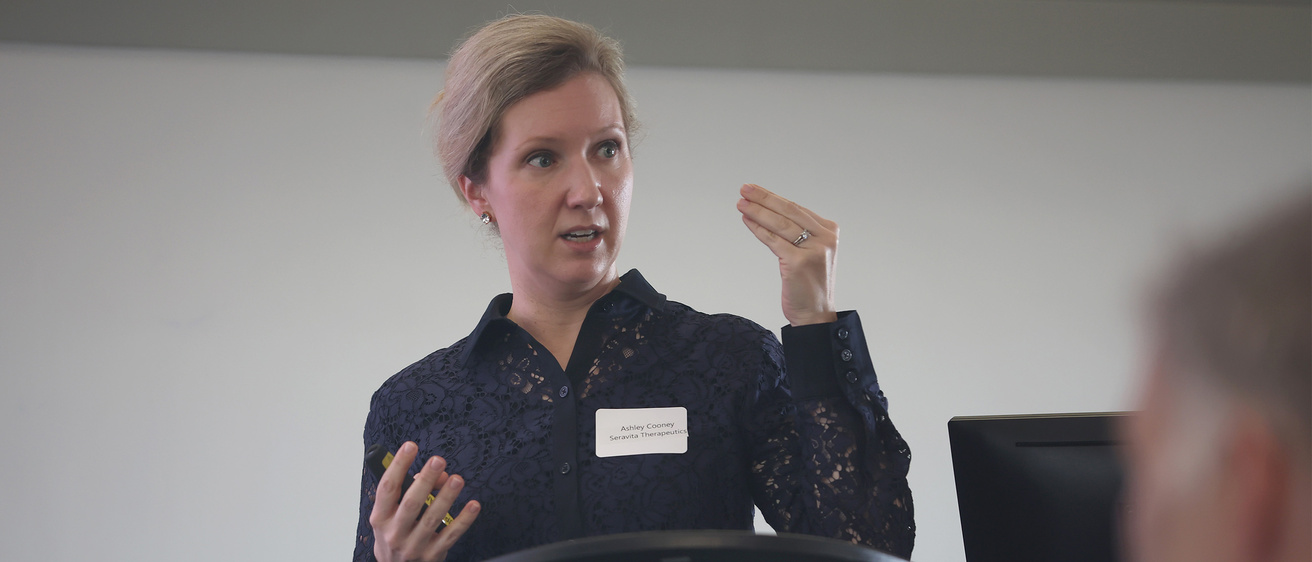
On the first day of a University of Iowa Office of Innovation Fellowship Program, Ashley Cooney introduced herself as a lung biologist. Optometrist Christine Sindt wasted no time: “I want to talk to you.” That conversation led to a breakthrough for patients with severely dry eyes.
Drawing on Cooney’s background, the pair repurposed pulmonary surfactant into an eye drop that protects the surface of the eye. Unlike existing treatments that quickly wash away with blinking, their creation stays in place for hours.
That chance conversation has gained momentum in 18 months. Seravita Therapeutics recently secured $30,000 through the University of Iowa’s Innovation Challenge, helping move the treatment toward final testing. Innovation Challenge is sponsored by the John Pappajohn Entrepreneurial Center (Iowa JPEC).
“When we used [the treatment] on ourselves, I thought, ‘OK, we need to get this to people as fast as possible,’” Cooney said.
A native of Decorah, Iowa, Cooney earned a bachelor’s degree (biological sciences) and PhD (microbiology and immunology) from the University of Iowa. Along with Sindt, the duo co-founded Seravita Therapeutics with a goal of developing relief for people with pathologic dry eye. An early version of pulmonary surfactant that didn’t work well in the lungs worked well on the eye. The result? Increased comfort and an increased tear film height when it was put on eyes for hours compared to available therapies that only last a few blinks.
The rapid success wasn’t a surprise to Cooney or Sindt. “It was intelligent design,” Cooney said. “There is a strong foundation and rationale for why this would work.”
The meeting between Cooney and Sindt occurred in August of 2024 after Cooney joined the Office of Innovation Leadership Program. Sindt was in attendance to discuss innovation as a guest speaker.
“In a year and a half, we have made it this far,” Cooney said. “We’re ready to license it.”
During those 18 months, Cooney familiarized herself with the art of pitching at various entrepreneurial competitions. On two occasions, their product received University of Iowa Carver College of Medicine GAP Funds. After the win at Innovation Challenge, Cooney said she has her eyes set on other competitions.
“We got something to work, tweaked it a few times, and it is remarkable even to me,” Cooney said. “[Innovation Challenge] was my first exposure to Iowa JPEC, so I’m certainly going to look at other opportunities. Iowa JPEC is going to allow us to get this product over the finish line to complete our Phase 3 trial and then we will be able to license it. It is helping us wrap up the project.”
What might seem like quick success for Seravita Therapeutics is really the result of smart ideas and the right team pushing each other. It’s been built in a short amount of time, with a lot of thought behind every step. Now, as it moves into testing, there’s a sense that this is only the beginning.
What began with a simple introduction has turned into something much bigger. With a strong foundation and steady progress, Seravita Therapeutics is closing in on the next phase. There’s still work ahead, but the path is clear, and for patients searching for lasting relief, that’s what matters most.
Wednesday, May 27, 2026